B2B Lead Qualification Framework: Convert More Prospects into Customers
K
By Krishna Vepakomma
Sales & AI Expert
28th December 2024
14 min read
2796 words
By Krishna Vepakomma
Sales & AI Expert
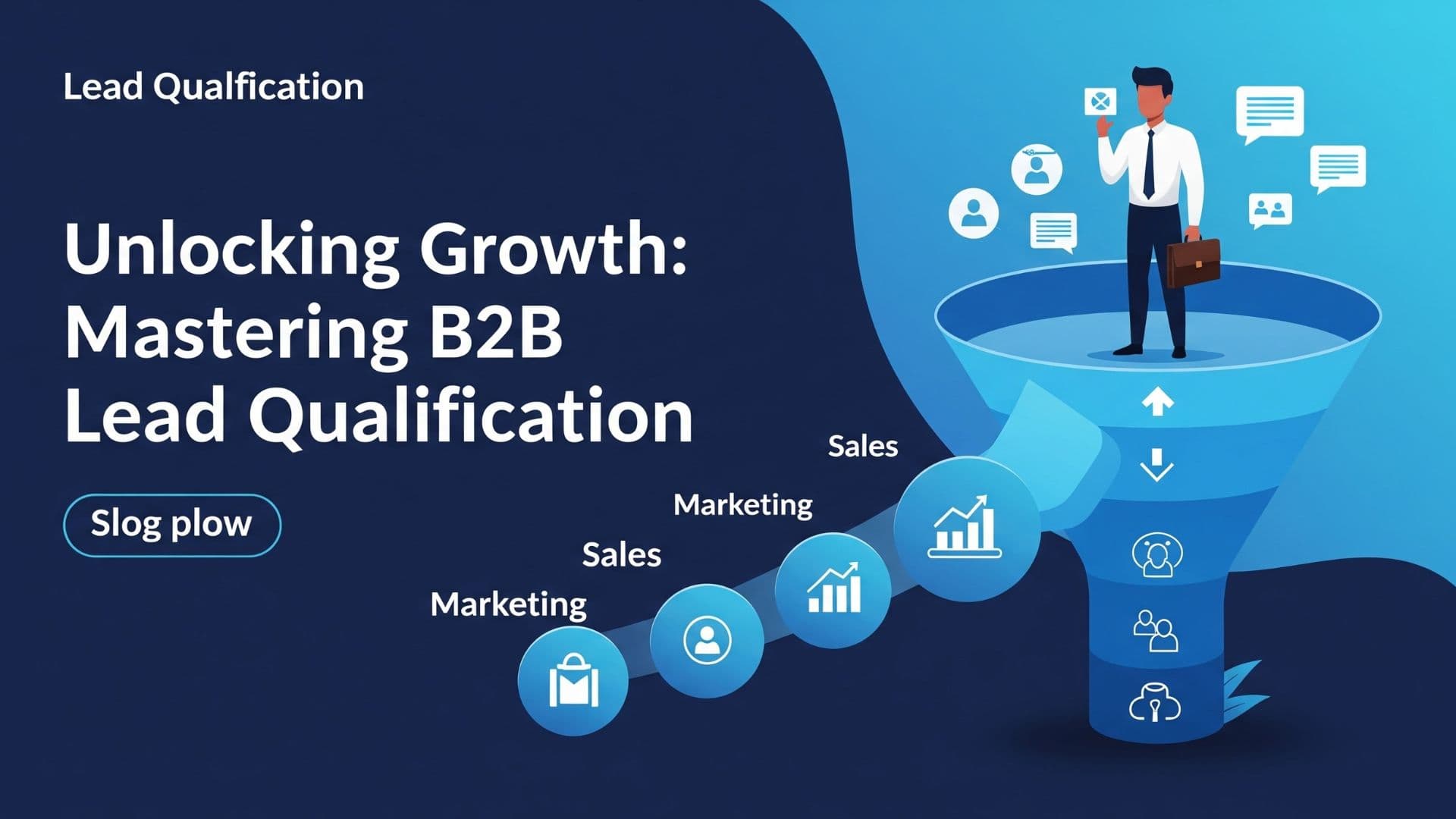
Master B2B lead qualification with proven frameworks like BANT, MEDDIC, and CHAMP. Learn how to identify sales-ready prospects, improve conversion rates, and streamline your sales process with effective qualification strategies.
B2B lead qualification is the systematic process of evaluating prospects to determine their likelihood of becoming customers. It involves assessing factors such as budget, authority, need, timing, and decision-making process to identify which leads deserve immediate sales attention versus continued nurturing. Effective lead qualification saves time, increases conversion rates, and improves sales efficiency by ensuring sales teams focus on prospects most likely to purchase. It bridges the gap between marketing-generated leads and sales-ready opportunities, creating a smoother handoff and better alignment between teams. Studies show that companies with effective lead qualification processes see 68% higher conversion rates and 67% reduction in sales cycle length. Additionally, sales teams that use structured qualification frameworks report 28% more closed deals and 18% higher average deal values.
Proper qualification maximizes sales team effectiveness: - Time optimization: Focus on high-probability prospects - Resource allocation: Direct efforts toward qualified opportunities - Pipeline quality: Maintain healthier, more predictable sales pipeline - Forecasting accuracy: Better prediction of revenue outcomes - Team morale: Higher success rates boost sales team confidence
Qualified leads generate better business results: - Higher conversion rates: 35-50% improvement in lead-to-customer conversion - Shorter sales cycles: 25-40% reduction in time to close - Larger deal sizes: 15-25% increase in average contract value - Better customer retention: Qualified customers have higher satisfaction - Predictable growth: More consistent revenue performance
Qualification improves prospect experience: - Relevant conversations: Focused discussions on real needs - Appropriate timing: Engagement when prospects are ready - Valuable interactions: Meaningful exchanges that provide value - Reduced pressure: Less aggressive pursuit of unqualified leads - Trust building: Professional approach builds credibility
Budget, Authority, Need, Timeframe - the classic qualification model: Budget - Does the prospect have financial resources available? - What is their budget range for this type of solution? - How do they typically allocate funds for similar purchases? - Who controls the budget and approval process? - When is budget typically allocated or renewed? Authority - Who makes the final purchasing decision? - What is the prospect's role in the decision-making process? - Who else is involved in the evaluation and selection? - What is the typical decision-making hierarchy? - How much influence does this contact have? Need - What specific problems are they trying to solve? - How significant is the impact of the current situation? - What happens if they don't address this need? - How have they attempted to solve this previously? - What are their success criteria for a solution? Timeframe - When do they need to have a solution in place? - What is driving the urgency of this timeline? - Are there external factors influencing timing? - What are the consequences of delay? - How does this fit into their broader strategic planning? BANT Scoring Example: - Budget confirmed: 25 points - Decision-maker identified: 25 points - Clear business need: 25 points - Defined timeline: 25 points - Total: 75+ points = Qualified lead
Metrics, Economic Buyer, Decision Criteria, Decision Process, Identify Pain, Champion: Metrics - How will success be measured? - What are the quantifiable benefits expected? - What metrics will improve with your solution? - How will ROI be calculated and evaluated? - What are the current baseline measurements? Economic Buyer - Who has the budget and authority to purchase? - What are their priorities and concerns? - How do they typically evaluate investments? - What is their decision-making style? - What would make them say yes or no? Decision Criteria - What requirements must the solution meet? - How will different options be evaluated? - What are the must-have versus nice-to-have features? - Who establishes the evaluation criteria? - How are trade-offs typically made? Decision Process - What steps are involved in making this decision? - Who participates in each stage of the process? - What approvals are required and from whom? - How long does the process typically take? - What could cause delays or derail the process? Identify Pain - What problems are they experiencing currently? - What is the cost of not solving these problems? - How urgent is the need for a solution? - What attempts have been made to address this? - Who is most affected by these issues? Champion - Who internally advocates for your solution? - What is their influence and credibility? - Why are they motivated to help you succeed? - How can you support and enable them? - What do they need to build internal support?
Challenges, Authority, Money, Prioritization: Challenges - What business challenges are they facing? - How do these challenges impact their success? - What are the root causes of these challenges? - How have they attempted to address them? - What would happen if challenges remain unresolved? Authority - Who has the power to make this decision? - What is the decision-making structure? - How are purchasing decisions typically made? - Who else influences the decision? - What is required for final approval? Money - Is budget available for this type of solution? - How much are they willing to invest? - What is the budget approval process? - When is budget allocated or reviewed? - What ROI expectations exist? Prioritization - How important is solving this problem? - Where does this rank among other initiatives? - What would cause this to become higher priority? - What could derail or delay this priority? - Who determines priority levels?
Funds, Authority, Interest, Need, Timing: Funds - Are financial resources available? - What is the budget range or allocation? - How is funding typically secured? - What financial approval is required? - When are budget decisions made? Authority - Who makes the final decision? - What is the decision-making hierarchy? - How much influence does this contact have? - Who else is involved in the process? - What consensus is required? Interest - How engaged is the prospect? - What is their level of curiosity about solutions? - Are they actively seeking information? - How responsive are they to communications? - What questions are they asking? Need - What specific business need exists? - How critical is addressing this need? - What is the impact of the current situation? - How urgent is finding a solution? - What are the consequences of inaction? Timing - When do they plan to make a decision? - What drives their timeline? - Are there external factors affecting timing? - How flexible is their schedule? - What could accelerate or delay their process?
Identifying Core Problems - Surface-level symptoms versus root causes - Quantifying impact and consequences - Understanding stakeholder perspectives - Mapping problems to business objectives - Assessing urgency and priority levels Problem Qualification Questions - "What challenges are you currently facing with [specific area]?" - "How is this problem affecting your team/department/company?" - "What happens if this issue isn't resolved?" - "How much time/money is this costing you?" - "What attempts have you made to solve this?"
Decision-Making Unit Analysis - Decision Maker: Final authority and budget control - Influencers: Technical and business advisors - Users: End-users who will work with the solution - Gatekeepers: Control access to decision makers - Saboteurs: Potential opponents or obstacles Stakeholder Qualification Matrix - Level of influence (High/Medium/Low) - Level of support (Supporter/Neutral/Opponent) - Accessibility (Easy/Moderate/Difficult) - Information needs (Technical/Business/Financial) - Communication preferences (Email/Phone/In-person)
Competitive Positioning Assessment - What alternatives are being considered? - Who are the main competitors in evaluation? - What are their decision criteria priorities? - What advantages do competitors offer? - How can you differentiate your approach? Competitive Intelligence Questions - "What other solutions are you evaluating?" - "What do you like about the alternatives?" - "What concerns do you have about other options?" - "How are you planning to make your final decision?" - "What would make one solution clearly better than others?"
Opening and Rapport Building - Personal connection and relationship establishment - Company and role understanding - Current situation and context setting - Meeting objectives and agenda alignment - Permission to ask detailed questions Situation Analysis - Current state assessment and baseline understanding - Existing tools and processes in use - Team structure and responsibilities - Historical context and previous attempts - Success metrics and measurement approaches Problem Exploration - Specific challenges and pain points - Impact analysis and consequences - Root cause identification - Stakeholder effects and perspectives - Urgency and priority assessment Solution Fit Assessment - Requirements gathering and prioritization - Success criteria definition - Technical and business constraints - Integration and implementation considerations - Change management and adoption factors Next Steps and Commitment - Mutual agreement on fit and interest - Clear next steps and timeline - Resource requirements and availability - Decision-making process and timeline - Follow-up schedule and expectations
Weighted Scoring Model - Assign weights to each qualification criterion - Score each criterion on consistent scale (1-5 or 1-10) - Calculate weighted total score - Establish thresholds for qualification levels - Regular review and calibration of scoring Example Scoring Framework: - Budget (30%): Confirmed budget = 5, Estimated budget = 3, No budget discussion = 1 - Authority (25%): Decision maker = 5, Strong influencer = 3, No authority = 1 - Need (25%): Critical business need = 5, Important need = 3, Nice to have = 1 - Timing (20%): Immediate need = 5, 6-month timeline = 3, Future consideration = 1 Qualification Thresholds: - Highly Qualified (4.0-5.0): Immediate sales attention - Qualified (3.0-3.9): Active sales development - Partially Qualified (2.0-2.9): Continued nurturing - Unqualified (1.0-1.9): Long-term nurturing or disqualification
Lead Qualification Fields - Structured data capture for qualification criteria - Dropdown menus and standardized options - Mandatory fields for key qualification information - Historical tracking of qualification changes - Integration with lead scoring models Workflow Automation - Automatic lead routing based on qualification - Task creation for follow-up activities - Alert generation for sales team - Campaign enrollment based on qualification level - Reporting and analytics automation
Qualification Software Platforms - Salesforce: Comprehensive CRM with custom qualification fields - HubSpot: Built-in qualification tools and workflows - Pipedrive: Visual pipeline with qualification stages - Inleads.ai: AI-powered qualification and lead scoring - Outreach: Sales engagement with qualification sequences Conversation Intelligence - Gong: Call analysis and qualification insight extraction - Chorus: Meeting intelligence and talk pattern analysis - ExecVision: Conversation coaching and qualification training - Revenue.io: Real-time conversation guidance - Refract: Call analysis and performance improvement
Machine Learning Applications - Predictive qualification: AI-generated qualification scores - Pattern recognition: Identification of qualification indicators - Natural language processing: Analysis of email and call content - Behavioral analysis: Website and engagement pattern evaluation - Intent detection: Buying signal identification and scoring Automated Qualification Features - Lead scoring integration: Combined qualification and scoring models - Dynamic questioning: Adaptive qualification questions - Real-time recommendations: Next-best-action suggestions - Risk assessment: Early warning for deal risks - Competitive intelligence: Automated competitor identification
Question Techniques - Open-ended questions: Encourage detailed responses - Follow-up probing: Dig deeper into initial answers - Hypothetical scenarios: Explore decision-making approaches - Pain amplification: Understand full impact of problems - Vision casting: Help prospects see potential outcomes Active Listening Skills - Full attention: Focus completely on prospect responses - Note-taking: Capture important details and insights - Clarification: Ensure understanding of complex points - Summarization: Confirm understanding and agreement - Empathy: Show understanding of prospect challenges
Premature Solution Presentation - Problem: Jumping to solution before full qualification - Solution: Complete discovery before any solution discussion - Impact: Better fit assessment and higher conversion rates Surface-Level Questioning - Problem: Accepting initial answers without deeper exploration - Solution: Use follow-up questions and probing techniques - Impact: Better understanding of true needs and urgency Single-Threaded Relationships - Problem: Qualifying only with one contact - Solution: Map and engage multiple stakeholders - Impact: Reduced risk and better decision process understanding Qualification Shortcuts - Problem: Skipping qualification steps to speed up process - Solution: Maintain discipline in qualification process - Impact: Higher qualification accuracy and conversion rates
Technical Qualification - Current technology stack and integrations - Technical requirements and constraints - Implementation timeline and resources - Security and compliance requirements - Scalability and performance needs Usage and Adoption Factors - Number of users and user types - Current tools and workflow processes - Change management and training needs - Success metrics and KPI tracking - Support and maintenance expectations
Service Qualification - Scope of work and project requirements - Internal capabilities and resource gaps - Timeline and milestone expectations - Budget and pricing model preferences - Previous experience with similar services Relationship Factors - Working style and communication preferences - Team dynamics and collaboration needs - Reporting and progress tracking requirements - Risk tolerance and quality expectations - Long-term relationship potential
Operational Qualification - Production requirements and specifications - Quality standards and certifications - Supply chain and logistics considerations - Regulatory and compliance requirements - Maintenance and support needs Business Impact Assessment - Cost reduction and efficiency improvements - Revenue impact and growth potential - Risk mitigation and reliability factors - Competitive advantage opportunities - Return on investment calculations
Qualification Quality Metrics - Lead acceptance rate: Percentage of qualified leads accepted by sales - Conversion rate by qualification level: Performance across qualification tiers - False positive rate: Qualified leads that don't convert - False negative rate: Unqualified leads that do convert - Time to qualification: Speed of qualification process Sales Impact Metrics - Sales cycle length: Impact of qualification on deal velocity - Deal size: Correlation between qualification and contract value - Win rate: Conversion rate improvement from qualification - Pipeline velocity: Movement through sales stages - Sales productivity: Efficiency improvements from qualification
Regular Review and Calibration - Monthly qualification reviews: Accuracy and effectiveness assessment - Quarterly framework updates: Refinement based on performance data - Semi-annual training refreshers: Skill development and best practice sharing - Annual framework overhaul: Comprehensive review and optimization - Ongoing coaching and feedback: Individual improvement and development Data-Driven Optimization - A/B testing: Different qualification approaches and questions - Cohort analysis: Performance comparison across time periods - Predictive modeling: Machine learning-enhanced qualification - Feedback loops: Sales team input and prospect feedback - Benchmark comparisons: Industry and competitive performance analysis
B2B lead qualification is a critical capability that directly impacts sales efficiency, conversion rates, and revenue growth. By implementing structured qualification frameworks, leveraging appropriate technology, and continuously optimizing processes, organizations can significantly improve their sales performance. The key to successful qualification lies in understanding your customers deeply, asking the right questions, and maintaining discipline in the qualification process. As technology advances, AI and automation will enhance qualification capabilities while human insight and relationship skills remain essential. Companies that invest in comprehensive qualification programs position themselves for sustained competitive advantage in customer acquisition and growth. The combination of proven frameworks, modern technology, and ongoing optimization creates powerful systems for identifying and converting high-value prospects. Ready to implement advanced lead qualification for your business? Explore Inleads.ai's intelligent qualification platform and discover how AI-powered tools can transform your lead qualification and conversion rates.
Discover more insights about AI sales tools and analytics