Lead Scoring Models: Complete Guide to Prioritizing Your Best Prospects
K
By Krishna Vepakomma
Sales & AI Expert
28th December 2024
12 min read
2340 words
By Krishna Vepakomma
Sales & AI Expert
Master lead scoring with proven models, implementation strategies, and best practices. Learn how to identify your hottest prospects, improve sales efficiency, and increase conversion rates with intelligent lead prioritization.
Lead scoring is a systematic approach to ranking prospects based on their perceived value and likelihood to convert into customers. It assigns numerical values to leads based on various attributes, behaviors, and interactions, helping sales and marketing teams prioritize their efforts on the most promising opportunities. Effective lead scoring combines demographic information (who they are) with behavioral data (what they do) to create a comprehensive view of each prospect's sales readiness. This data-driven approach enables teams to focus resources on leads most likely to generate revenue while nurturing less-qualified prospects until they're ready to buy. Companies using lead scoring see 77% improvement in lead generation ROI and 80% increase in sales productivity. Additionally, organizations with mature lead scoring processes generate 192% higher average revenue per email than those without.
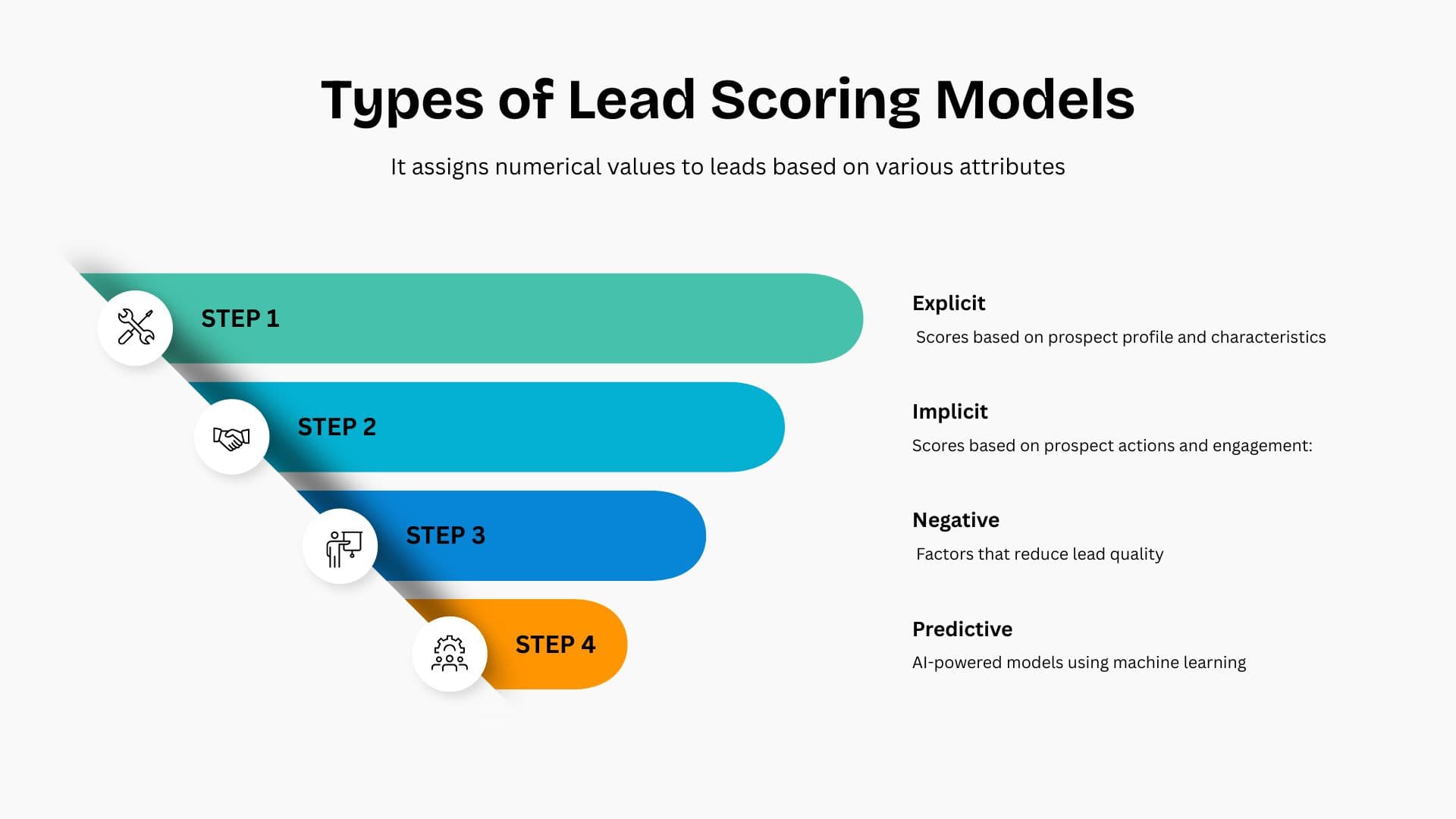
Scores based on prospect profile and characteristics: Company Attributes - Industry: Different sectors may have varying fit levels - Company size: Revenue, employee count, market cap - Geographic location: Target markets and territories - Technology stack: Current tools and systems in use - Growth stage: Startup, established, enterprise level Individual Attributes - Job title and seniority: Decision-making authority - Department: Alignment with your solution's impact area - Years of experience: Professional maturity and influence - Education level: Technical understanding and sophistication - Professional network: Industry connections and influence Scoring Example: - C-Level Executive: +20 points - VP/Director: +15 points - Manager: +10 points - Individual Contributor: +5 points - Non-target role: -5 points
Scores based on prospect actions and engagement: Website Behavior - Page visits: Frequency and recency of site visits - Content consumption: Time spent on key pages - Resource downloads: Ebooks, whitepapers, case studies - Pricing page views: Interest in commercial information - Contact page visits: Intent to engage directly Email Engagement - Open rates: Consistent email engagement - Click-through rates: Active interest in content - Reply rates: Direct response and interaction - Forward/share rates: Content amplification - Unsubscribe behavior: Negative engagement signals Content Interaction - Webinar attendance: Educational engagement - Video completion rates: Depth of content consumption - Social media engagement: Sharing and commenting - Blog comment participation: Active community involvement - Resource library usage: Self-service learning behavior Scoring Example: - Pricing page visit: +15 points - Case study download: +10 points - Blog post read: +5 points - Email open: +2 points - Unsubscribe: -10 points
Factors that reduce lead quality: Disqualifying Attributes - Competitor employees: Direct competitors - Students and job seekers: Non-buying personas - Personal email addresses: Non-business prospects - Restricted industries: Compliance or strategic limitations - Geographic exclusions: Unsupported territories Negative Behaviors - Unsubscribe actions: Lost interest or poor fit - Spam complaints: Negative brand interaction - Bounced emails: Invalid contact information - Low engagement: Consistent non-participation - Rapid site exits: Lack of genuine interest
AI-powered models using machine learning: Data-Driven Insights - Historical conversion patterns: Learning from past successes - Lookalike modeling: Finding similar high-value prospects - Behavioral pattern recognition: Complex interaction analysis - External data integration: Market and industry signals - Real-time score adjustments: Dynamic scoring updates Advanced Analytics - Propensity modeling: Likelihood to convert predictions - Churn prediction: Risk of losing interested prospects - Timing optimization: Best moment for sales outreach - Channel preference: Optimal communication methods - Content recommendations: Most relevant resource suggestions
Analyze Your Best Customers - Review successful customers from past 12-24 months - Identify common demographic characteristics - Analyze behavioral patterns leading to conversion - Calculate average deal size and sales cycle length - Document common pain points and use cases Create Customer Personas - Primary decision-maker characteristics - Influencer and stakeholder profiles - Typical buying process and timeline - Preferred communication channels and content - Common objections and concerns
Demographic Criteria - Company size (revenue, employees) - Industry and market segment - Geographic location and territory - Technology infrastructure - Growth stage and funding status Behavioral Criteria - Website engagement and navigation patterns - Content consumption and interaction depth - Email response and engagement rates - Event attendance and participation - Sales interaction quality and frequency Timing Criteria - Recency of interactions and engagement - Frequency of touchpoints and communications - Response time to outreach and follow-up - Seasonal or cyclical buying patterns - Budget timing and purchase windows
Point Scale Selection - Choose appropriate scale (0-100, 0-1000, etc.) - Ensure meaningful differentiation between scores - Allow for both positive and negative scoring - Consider score decay for time-sensitive actions - Plan for easy adjustment and optimization Value Assignment Framework - Highest points for strongest buying signals - Medium points for general interest indicators - Low points for basic engagement activities - Negative points for disqualifying attributes - Bonus points for multiple related actions
Lead Grade Categories - Hot Leads (80-100 points): Immediate sales outreach - Warm Leads (60-79 points): Qualified sales development - Developing Leads (40-59 points): Continued nurturing - Cold Leads (20-39 points): Basic awareness building - Disqualified (0-19 points): Remove from active campaigns Action Triggers - Automatic sales alerts for hot leads - Campaign enrollment for warm leads - Nurturing sequences for developing leads - Re-engagement campaigns for cold leads - Suppression lists for disqualified leads
High-Value Behaviors - Free trial signup: +25 points - Product demo request: +20 points - Integration documentation access: +15 points - API documentation viewing: +10 points - Community forum participation: +8 points Demographic Factors - Technical role (CTO, Developer): +15 points - Growth-stage company: +12 points - Technology sector: +10 points - Team size 10-500: +8 points - VC-backed company: +5 points
High-Value Behaviors - Consultation request: +30 points - Case study download: +20 points - Service page visits: +15 points - Team page viewing: +10 points - Testimonial section engagement: +8 points Demographic Factors - C-level executive: +25 points - Target industry: +15 points - Company size 50-1000: +12 points - Previous service experience: +10 points - Geographic territory: +8 points
High-Value Behaviors - Quote request: +35 points - Product specification download: +25 points - Compliance documentation access: +20 points - Trade show attendance: +15 points - Industry report download: +10 points Demographic Factors - Procurement role: +20 points - Manufacturing industry: +15 points - Enterprise size: +12 points - Supply chain position: +10 points - Certification requirements: +8 points
Enterprise Solutions - Marketo: Advanced predictive scoring with AI capabilities - Pardot: Salesforce-integrated scoring with custom models - Eloqua: Oracle's sophisticated scoring and grading system - Adobe Campaign: Comprehensive customer journey scoring Mid-Market Solutions - HubSpot: User-friendly scoring with machine learning features - ActiveCampaign: Behavioral-based scoring with automation - Mailchimp: Basic scoring features with audience segmentation - ConvertKit: Simple scoring for content creators and coaches Specialized Platforms - Inleads.ai: AI-powered predictive scoring with growth analytics - MadKudu: Dedicated lead scoring and customer intelligence - Leadspace: B2B data and predictive lead scoring platform - 6sense: Account-based predictive scoring and intelligence
Salesforce Integration - Custom lead scoring fields and calculations - Workflow rules for automatic score updates - Reports and dashboards for score analysis - Sales alert automation based on score thresholds - Historical scoring data and trend analysis HubSpot CRM Integration - Native scoring properties and calculations - Automated list segmentation based on scores - Sales notification workflows - Score-based lead routing and assignment - Integrated reporting and analytics
Account for the diminishing value of older interactions: - Recent activity (0-7 days): Full point value - Medium recency (8-30 days): 75% point value - Older activity (31-90 days): 50% point value - Stale activity (90+ days): 25% point value - Very old activity (180+ days): 0% point value
Gradually increase requirements for advancement: - Initial engagement: Easy qualification thresholds - Continued interest: Moderate engagement requirements - Active evaluation: High-value behavior requirements - Purchase consideration: Premium content and interaction - Decision stage: Direct sales engagement and demos
Score accounts holistically rather than individual contacts: - Account-level demographics: Company fit scoring - Collective engagement: Combined contact interactions - Stakeholder mapping: Decision-maker involvement scoring - Intent signals: Company-wide buying behavior - Competitive activity: Market position and timing
Scoring Effectiveness Metrics - Lead-to-opportunity conversion rate: By score ranges - Sales cycle length: Impact of scoring on velocity - Deal size correlation: Score relationship to revenue - Sales acceptance rate: Quality of scored leads - Time to conversion: Speed from scoring to sale Model Performance Metrics - Score distribution: Proper spread across ranges - Threshold effectiveness: Accuracy of grade boundaries - False positive rate: High scores that don't convert - False negative rate: Low scores that do convert - Model drift: Changes in scoring accuracy over time
Regular Model Reviews - Monthly performance analysis: Score accuracy assessment - Quarterly threshold adjustments: Boundary optimization - Semi-annual model updates: Criteria refinement - Annual complete overhaul: Fundamental model revision - Continuous testing: A/B test scoring variations Data Quality Management - Data validation: Ensure accurate input information - Duplicate management: Prevent scoring errors from duplicates - Integration monitoring: Verify data flow between systems - Behavioral tracking: Confirm action attribution accuracy - Score auditing: Regular manual verification of calculations
Challenge: Not enough behavioral data to score effectively Solutions: - Start with demographic scoring only - Implement progressive profiling strategies - Increase content offerings to generate behavior - Use third-party data enrichment services - Focus on fewer, higher-quality scoring criteria
Challenge: Sales reps don't trust or use scoring results Solutions: - Involve sales in model development process - Provide transparency into scoring methodology - Share success stories and conversion data - Offer scoring override capabilities - Regular training and feedback sessions
Challenge: Overly complex models that are difficult to manage Solutions: - Start simple and add complexity gradually - Focus on highest-impact scoring criteria - Implement automated model management - Regular simplification and cleanup reviews - Clear documentation and training materials
Machine Learning Enhancements - Automated model creation: AI-generated scoring models - Real-time optimization: Continuous learning and adjustment - Pattern recognition: Complex behavioral analysis - Predictive accuracy: Improved conversion predictions - Natural language processing: Content engagement analysis Advanced Analytics - Multi-modal scoring: Combining multiple data types - Ensemble models: Multiple algorithms working together - Deep learning: Neural network-based scoring - Reinforcement learning: Self-improving models - Causal inference: Understanding true impact factors
Third-Party Intent Signals - Search behavior: Industry-relevant search activity - Content consumption: External research patterns - Social media activity: Professional discussion participation - Event attendance: Industry conference and webinar activity - Technology adoption: Software installation and usage First-Party Intent Enhancement - Advanced web tracking: Detailed behavioral analysis - Email engagement depth: Beyond opens and clicks - Content progression: Journey through information - Time-based patterns: Timing and frequency analysis - Cross-device tracking: Unified engagement view
Lead scoring is a critical component of modern sales and marketing operations, enabling teams to prioritize efforts and resources on the most promising opportunities. When implemented correctly, lead scoring significantly improves conversion rates, reduces sales cycle length, and increases overall revenue efficiency. The key to successful lead scoring lies in understanding your customers deeply, implementing appropriate technology solutions, and continuously optimizing based on performance data. As AI and machine learning technologies advance, lead scoring will become even more sophisticated and accurate. Organizations that invest in comprehensive lead scoring programs position themselves for sustained competitive advantage in customer acquisition and growth. The combination of demographic insights, behavioral analysis, and predictive technology creates powerful systems for identifying and converting high-value prospects. Ready to implement intelligent lead scoring for your business? Explore Inleads.ai's AI-powered scoring platform and discover how predictive analytics can transform your lead prioritization and conversion rates.
Discover more insights about AI sales tools and analytics